
How can I protect my child’s hearing, and when should it be checked?
Protect your child’s ears from loud sound, including headphones, and watch how they respond to sound and speech. Ear infections and glue ear are common and usually clear, but get hearing checked if problems persist or you are worried. Emirates Audiology Centre in Abu Dhabi and Al Ain tests children’s hearing from the first weeks of life.
Published Next review
Why do ear infections and glue ear affect hearing?
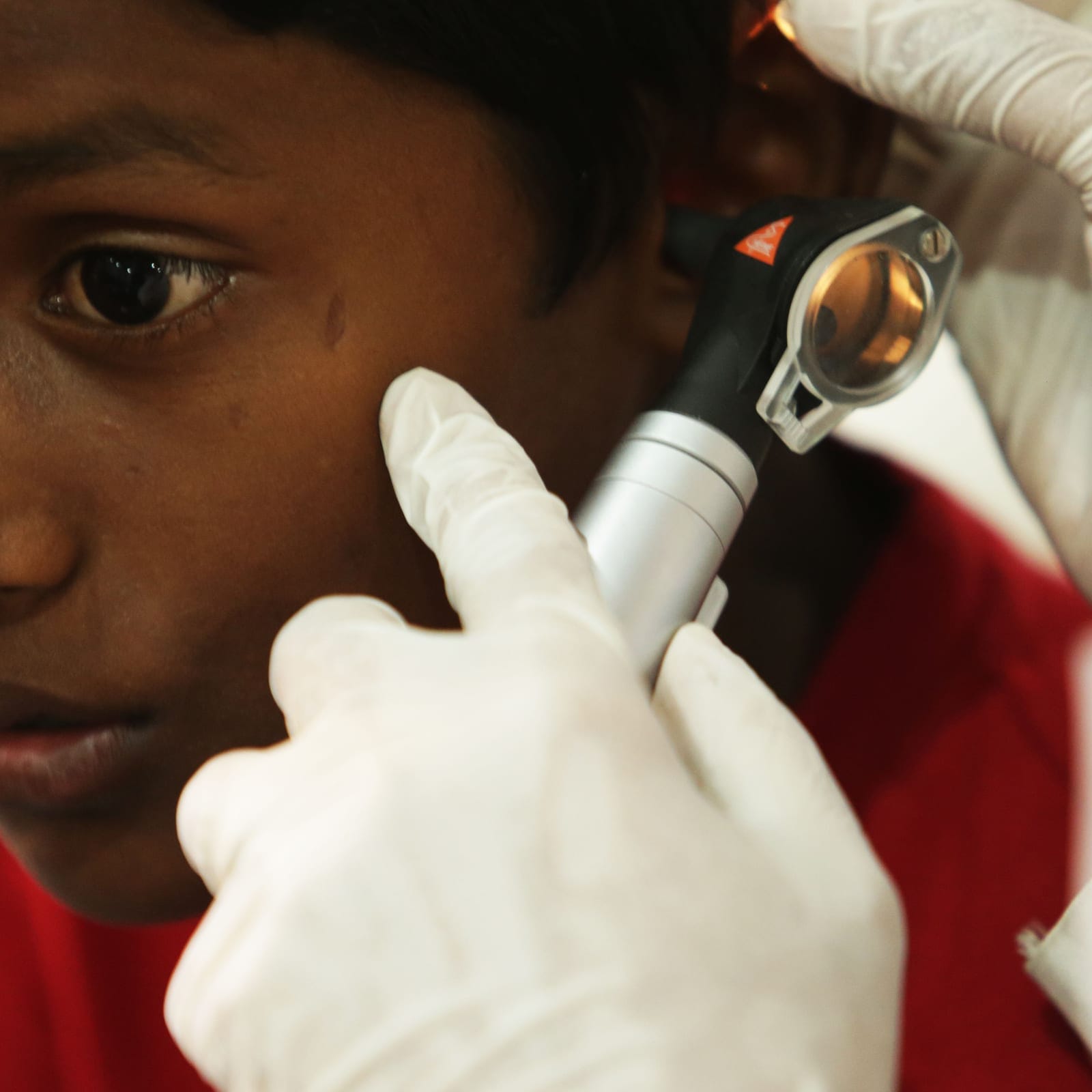
Sound passes through the middle ear, a small air-filled space behind the eardrum. In an ear infection, fluid builds up there, and children are prone to it, partly because the tubes that drain the middle ear are smaller and more level than an adult’s. Five out of six children have at least one ear infection by their third birthday. Fluid can also stay after an infection has cleared, or collect without one; this is glue ear. It causes a temporary hearing loss in one or both ears, and usually clears up within three months. If it lasts, it can affect speech and progress at school.
What signs of a hearing problem should I look out for?
Young children often cannot tell you they are not hearing well, so the signs tend to show in behaviour:
- Wanting the television or music louder than the rest of the family
- Asking people to repeat themselves, or speaking loudly
- Not answering when called from another room
- Seeming distracted, tired or irritable when people are talking
- Tugging or pulling at the ears, earache, or fluid coming from an ear
- Clumsiness or problems with balance
Fluid coming from an ear, or earache with a fever, needs a doctor. Sudden hearing loss in one ear is urgent: call or see a doctor the same day — treatment works best when it starts early.
What should my child be hearing and saying at each age?
Children develop at their own pace, and many reach a milestone only towards the end of an age range. As a rough guide, most children:
- By three months, react to loud sounds and calm down when they hear your voice
- By six months, follow sounds with their eyes and babble using many different sounds
- By their first birthday, turn towards sounds, respond to simple requests such as “come here”, and say one or two words
- By two, follow simple instructions and put two words together
- By four, hear you call from another room and hear the television at the same volume as the rest of the family
If your child has not yet done any of these for their age, mention it to their doctor, and say if you think they may have trouble hearing.
Are headphones and loud events safe for children?
Loud sound tires the sensory cells of the inner ear, and with regular exposure the damage can become permanent. The World Health Organization advises keeping a device’s volume at no more than 60% of maximum, using well-fitted, noise-cancelling headphones so the volume does not need to rise, and taking regular breaks. Its standard for listening devices sets a lower weekly sound allowance for children than for adults — 75 decibels for 40 hours a week, against 80 — and recommends a parental volume limit. A simple test: if you have to raise your voice to be heard by someone an arm’s length away, it is too loud. At fireworks, concerts and other loud events, use ear protection.
When should my child’s hearing be checked?
Babies are usually screened in the first days after birth, but a pass then is not the end of the story, because hearing can change as children grow — through frequent ear infections, meningitis, head injuries or loud noise, for example. The American Academy of Pediatrics recommends hearing checks at ages 4, 5, 6, 8 and 10, then at least once between 11 and 14, 15 and 17, and 18 and 21. Do not wait for a scheduled check if you notice any of the signs above, if ear infections keep coming back, or if glue ear has lasted more than three months.
What happens at a children’s hearing check?
We test hearing from the first weeks of life, with the method matched to your child’s age. Babies are tested while settled or asleep, using otoacoustic emission testing, which measures the inner ear’s response to sound, and tympanometry, which checks how the eardrum moves. Older children play a simple listening game. It is painless, and we explain the results at the same visit. You do not need a referral to book. We also make custom swimming and noise-protection moulds in our own laboratory in Abu Dhabi.
Frequently asked questions
Can I lower my child’s chances of getting ear infections?
Yes, to a degree. Vaccination helps, including the yearly flu vaccine and the pneumococcal vaccine, and so do frequent handwashing, keeping your child away from cigarette smoke, and never putting a baby down to sleep with a bottle.
What happens if glue ear does not clear up?
Your child may be monitored for up to a year. If it is affecting their learning or development, a specialist may suggest temporary hearing aids or grommets — small tubes placed in the ear to drain fluid, which usually fall out on their own within 6 to 12 months.
Sources
- Glue ear — NHS
- Ear Infections in Children — National Institute on Deafness and Other Communication Disorders (NIDCD)
- Your Baby’s Hearing and Communicative Development Checklist — National Institute on Deafness and Other Communication Disorders (NIDCD)
- Deafness and hearing loss: Safe listening — World Health Organization
- WHO-ITU global standard for safe listening devices and systems: Summary — World Health Organization
- Hearing Screening for Newborns, Children & Adolescents: AAP Policy Explained — American Academy of Pediatrics (HealthyChildren.org)
This article is general information, not a diagnosis. For advice about your own hearing, book an assessment.